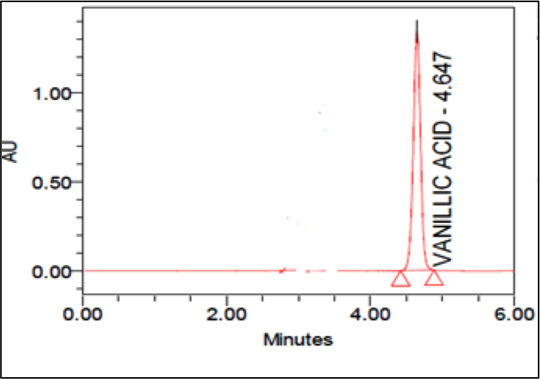
Figure 2: Chromatogram of vanillic acid in standard
Methanolic extract of Tecoma stans, Potassium dihydrogen phosphate, methanol, standard vanillic acid which was procured from Sigma Aldrich, Hyderabad, India
Plant Material:Fresh Tecoma stans leaves were collected from the botanical garden of Krupanidhi College of Pharmacy, Bangalore. The plant was authenticated by T.Manjulatha,HOD ,Department of Botany, JMJ College, Guntur .The Leaves were dried in the shade and powdered. About 200 gm of the powder was taken in a Soxhlet extractor and extracted with methanol. The solvent was recovered by distillation. The residue was concentrated, dried and stored in the desiccator for further analysis.
METHOD DEVELOPMENT: Preparation of vanillic acid standard solution:10 mg of standard vanillic acid was accurately weighed and transferred into 100ml volumetric flask, dissolved and diluted to 100ml with mobile phase. From the above solution 1 ml was transferred to 10 ml volumetric flask and make up the volume with mobile phase.
Preparation of sample solution:Accurately weighed about 10 mg of plant extract and transferred into 100ml volumetric flask dissolved and diluted to 100ml with mobile phase. From the above solution take 1 ml into 10 ml volumetric flask and make up the volume with mobile phase.
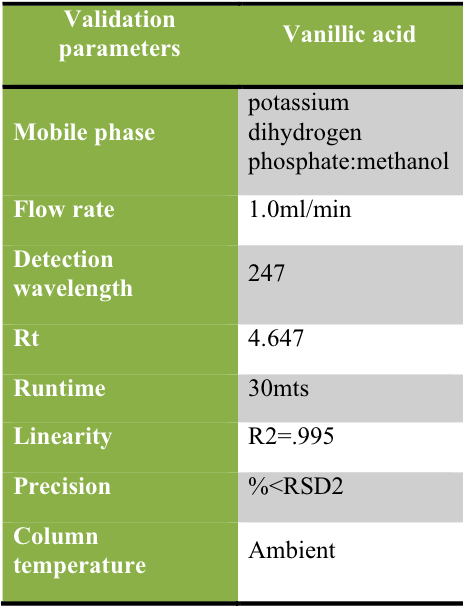
Chromatographic Condition The mobile phase was prepared separately with 0.1N Potassium dihydrogen phosphate buffer (mobile phase A) and methanol (mobile phase B) and mobile phase was eluted as per following gradient programming. The pH of the mobile phase (A) is maintained at 5.2 with prior correction with 10% phosphoric acid. The prepared buffer was filtered through a Millipore 0.45 µm membrane filter and ultrasonically degassed prior to use. The detection wavelength was set at 247 nm. The elution was done at a flow rate of 1.0 ml/min under ambient condition.
METHOD VALIDATION [18] PrecisionThe precision of an analytical procedure expresses the closeness of agreement between a series of measurements obtained from multiple sampling of the same sample under the conditions prescribed. Precision is usually considered at three levels: repeatability, intermediate precision and reproducibility. In this study repeatability of precision was evaluated by analysis of six replicates of sample solution of same concentration.
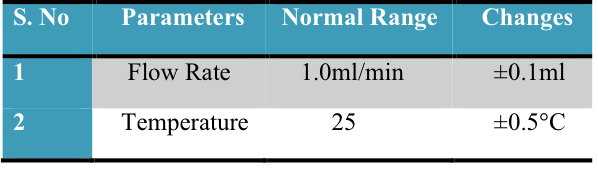
Robustness of the methodThe effects on the results were examined by introducing small changes in the mobile phase composition, mobile phase volume and duration of mobile phase saturation. Robustness was done in four replicates and % R.S.D peak area was calculated.
SpecificityVanillic acid in the sample was confirmed by comparing the Rf values with that of the standard to ascertain the specificity. The specificity of the method was evaluated with regard to interference due to presence of blank and any other excipients.
System suitabilityThe standard stock solution of vanillic acid was injected six times into HPLC system as per test procedure. The % RSD of retention times, tailing factor, theoretical plates and peak areas were evaluated from standard chromatograms for evaluating the system suitability parameters from six replicate injections.
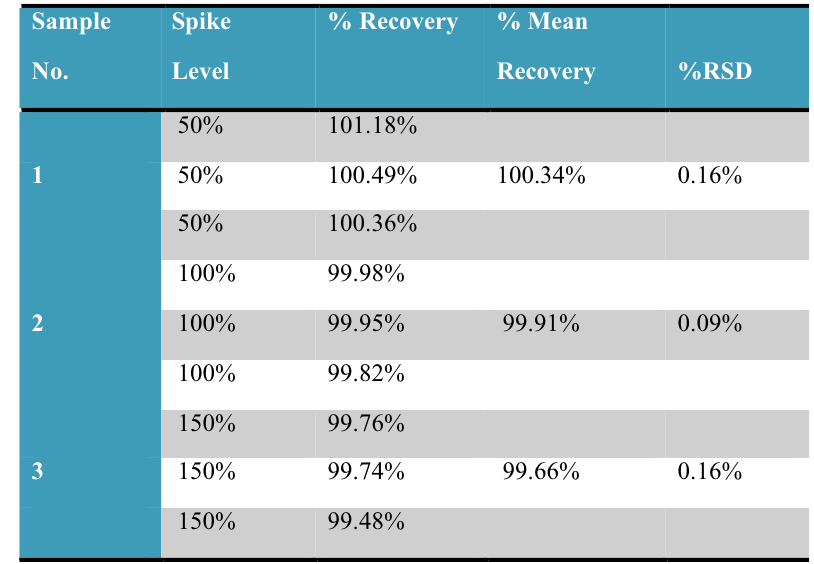
AccuracyAccuracy is a measure of the closeness of agreement between the value which accepted either as convectional true value & the value found. Assay was performed in triplicate for various concentrations of vanillic acid equivalent to 50%, 100 %, and 150 % of the standard amount, which were injected into the HPLC system per the test procedure. The average % recovery of vanillic acid was calculated.
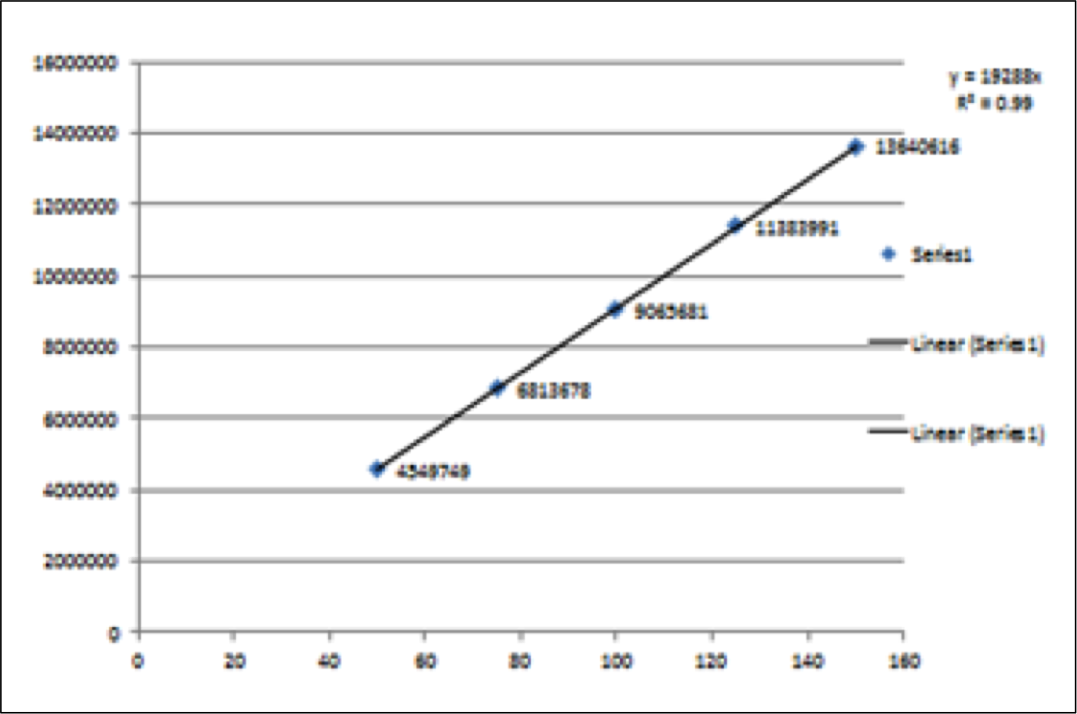
Linearity and RangeThe linearity of calibration curves in pure solution was checked over the concentration ranges of about 50%-150% (Assay concentration in mcg/ml) for vanillic acid.
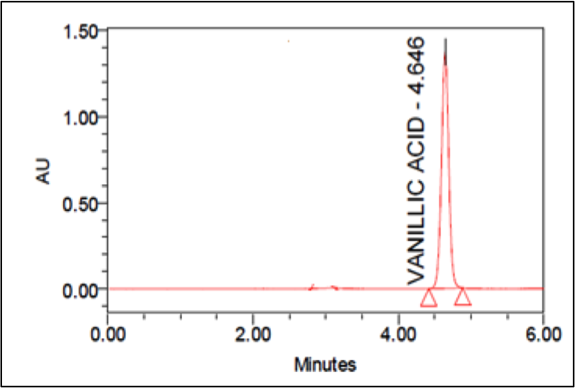
A new method was developed and validated using various parameters like accuracy, robustness, linearity and range. The best result was achieved by using Phenomenex (US) C18 Column 250 x 4.6mm I.D, 5μ Particle Size and mobile phase consisting of potassium dihydrogen phosphate: methanol (600:400) with a flow rate of 1.0 ml/min with SPD-M20A Diode Array Detector set at 247nm for vanillic acid. The retention time for vanillic acid is 4.647. The method produced linear responses in the concentration range of 50%-150%. The amount of vanillic acid was found to be 5.1mg/gm. The developed method was then validated by using various validation parameters. The figure shows that drug was clearly separated from blank and its excipients. The RSD for peak areas from six replicate injections of vanillic acid was found to be 0.2 %. The total eluting time was less than 25 min.The following tables and chromatograms depict the results of the method development and validation of vanillic acid.
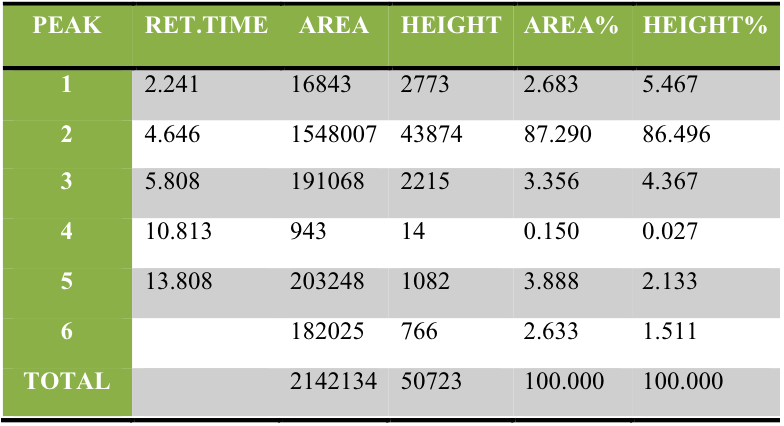
Specificity and selectivity: This was evaluated by examining the samples for any interfering peaks. The specificity of the method was evaluated taking into consideration, any interference due to presence of blank and any other excipients. The figure shows no interference and that the drug was clearly separated from blank and its excipients. Thus the proposed HPLC method is selective
Figure 1: Chromatogram of vanillic acid in sample
Figure 2: Chromatogram of vanillic acid in standard
1. Tecoma - Wikipedia tfe, en.wikipedia.org/wiki/Tecom. Retrieved on: 8-06- 2012, 9:30pm.
2. Raju S, Kavimani S, Uma MrV, Sreeramulu RK: Kyllinga nemoralis (Hutch & Dalz) (Cyperaceae): Ethnobotany, Phytochemistry and Pharmacology. Pharmacognosy Journal 2011, 3:7-10.
3. Das C, Mohanty A, Sahoo D, Dash S: Wound healing potential of methanolic extract of Tecoma stans Linn, Leaf. Drug Invention Today 2010, 2.
4. Lozoya-Meckes M, Mellado-Campos V: Is the< i> Tecoma stans infusion an antidiabetic remedy? Journal of ethnopharmacology 1985, 14:1-9.
5. Bahadoram S: Antispasmodic effect of Tecoma stans (L.) Juss leaf extract on rat ileum. DARU Journal of Pharmaceutical Sciences 2007, 15.
6. Gandhi MI, Ramesh S: Antifungal and haemolytic activities of organic extracts of Tecoma stans (Bignoniaceae). J Ecobiotechnol 2010, 2:26-32.
7. Govindappa M, Sadananda T, Channabasava R, Raghavendra VB: In vitro anti-inflammatory, lipoxygenase, xanthine oxidase and acetycholinesterase inhibitory activity of tecoma stans (l.) Juss. Ex kunth. International Journal of Pharma & Bio Sciences 2011, 2.
8. Hammouda Y, Lemen J, Plat M: structure de la tecostanine-alcaloide du tecoma stans juss. 3. Monoterpenoides. 2. Bulletin de la societe chimique de france 1963:2802-&.
9. Jones G, Ferguson G, Marsh WC: Stereochemistry and absolute configuration of tecomanine and alkaloid C, an oxygenated skytanthine, two monoterpene alkaloids from Tecoma stans. Journal of the Chemical Society D: Chemical Communications 1971:994-996.
10. Lins AP, Felicio JD: Monoterpene alkaloids from< i> Tecoma stans. Phytochemistry 1993, 34:876-878.
11. Gross D, Berg W, Schütte HR: Über das vorkommen monoterpenoider pyridinalkaloide in Actinidia arguta und Tecoma radicans. Phytochemistry 1972, 11:3082-3083.
12. Leal L, Pierdoná T, Góes J, Fonsêca K, Canuto K, Silveira E, Bezerra A, Viana G: A comparative chemical and pharmacological study of standardized extracts and vanillic acid from wild and cultivated< i> Amburana cearensis AC Smith. Phytomedicine 2011, 18:230-233.
13. Kim S-J, Kim M-C, Um J-Y, Hong S-H: The beneficial effect of vanillic acid on ulcerative colitis. Molecules 2010, 15:7208-7217.
14. Itoh A, Isoda K, Kondoh M, Kawase M, Kobayashi M, Tamesada M, Yagi K: Hepatoprotective effect of syringic acid and vanillic acid on concanavalin a-induced liver injury. Biological & pharmaceutical bulletin 2009, 32:1215-1219.
15. MeRkl R, HRádkoVá I, FIlIp V, Smidrkal J: Antimicrobial and antioxidant properties of phenolic acids alkyl esters. Czech J Food Sci 2010, 28:275-279.
16. Tai A, Sawano T, Ito H: Antioxidative properties of vanillic acid esters in multiple antioxidant assays. Bioscience, biotechnology, and biochemistry 2011, 76:314-318.
17.International Conference on harmonization. Method validation guidelines. www.ich.org (Accessed 20 March 13).
18. Swartz ME, Krull IS: Analytical method development and validation: CRC Press; 1997.